Timothy Cardinal Dolan, the Archbishop Emeritus of New York, delivered a talk on the life and legacy of the American Catholic evangelist Archbishop Fulton Sheen.
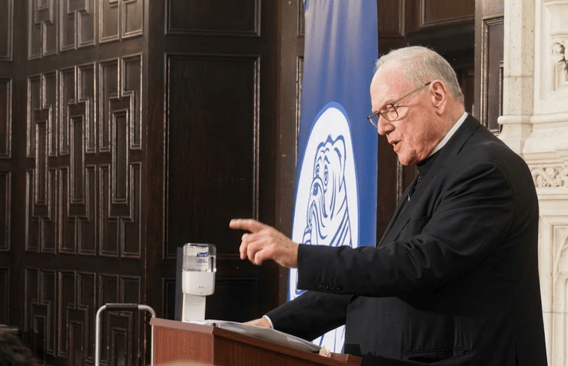
Cardinal Dolan speaks at Buckley Institute event. (Credit: Buckley Institute)
Jack Ehlert
Staff Writer, The Buckley Beacon
On September 17, the Buckley Institute hosted Timothy Cardinal Dolan, the former Archbishop of New York and a member of the College of Cardinals, to give a talk titled “Keeping the Faith: Religion in Modern American Life.” Speaking on the theme of religion and public life, the Cardinal examined the sometimes fraught relationship between Catholicism and mainstream American society.
The Cardinal, who holds a doctorate in American Church History from The Catholic University of America, officially retired as Archbishop of New York in February 2026 upon reaching the Church’s mandatory retirement age of 75. Over the course of his more than fifteen years as “archbishop of the capital of the world,” Cardinal Dolan straddled partisan lines, advocating against abortion and euthanasia while also supporting an increase in the New York State minimum wage. In 2012, the Cardinal delivered closing prayers at both the Republican and Democratic National Conventions.
Cardinal Dolan centered his talk around the life and legacy of the late Archbishop Fulton J. Sheen, an American prelate and public intellectual who lived from 1895 to 1979. Over the course of his life, Archbishop Sheen served as a Professor of Philosophy and Theology at The Catholic University of America before going on to start an Emmy Award-winning television show entitled “Life is Worth Living” in 1952. Next Thursday, September 24, Archbishop Sheen is set to be beatified in St. Louis, the first step towards canonization as a Catholic Saint.
Cardinal Dolan began his talk to a crowded Rosenfeld Hall by describing Archbishop Sheen as “a man who was a luminous example of religion and public life in the American experiment.” He continued, “He was handsome. He was witty. He was trim, all right? So in other words, I’m not very much like him, all right?”
Referring to Sheen as “the most effective evangelist, catechist, preacher, and teacher that the Catholic church in the United States has ever known,” the Cardinal praised Archbishop Sheen for bringing Catholicism into the American mainstream.
“My thesis is that the engine which drove Fulton John Sheen was an evangelical one.” Cardinal Dolan explained, “His was an intense desire to make the Catholic Church known, accepted, and appreciated in American society. And in doing so, to move Catholics in America from an outsider to an insider status within American culture.”
Cardinal Dolan discussed three trends in mid-century American society that the late Archbishop Sheen took advantage of in order to move Catholicism into the American mainstream. The Cardinal explained that the popularity of philosophy after World War I, the rising sentiment of anti-communism, and the religious revival of the 1950s set the stage for Archbishop Sheen’s evangelism to be as effective as it was.
“Fulton Sheen was a philosopher, first and foremost, even before he was a theologian,” the Cardinal remarked. “His goal as a priest would be to know two things: what the world is thinking about, and how to answer errors in the world in light of the philosophy of St. Thomas Aquinas.” Thomas Aquinas, who is considered a Doctor of the Church, was a thirteenth century philosopher and theologian whose thought remains foundational to Catholic philosophy to this day.
To support his claim about Archbishop Sheen’s influence on American Catholicism, Cardinal Dolan looked to the intellectual history of the early twentieth century. “In the nihilism after the First World War, intellectuals all over the world rediscovered the value of philosophy,” Cardinal Dolan explained. “[Sheen] would see here an opportunity to show how Catholics were right in the vanguard of this intellectual revival.”
In addition to spreading the “light of the philosophy of St. Thomas Aquinas,” Archbishop Sheen joined many Americans in rallying against communism. “Catholic social principles,” Cardinal Dolan remarked, “presented the golden mean between godless communism and selfish capitalism.”
“No nation was more vehemently opposed to communism than the United States of America,” the Cardinal remarked, “and no religion was more strenuously opposed to communism than Catholicism.”
On his third point, regarding the religious revival of the 1950s, the Cardinal discussed what he called the “interdenominational trinity” of Billy Graham, Norman Vincent Peale, and Fulton J. Sheen. Despite the fact that Archbishop Sheen was a Catholic while Graham and Peale were Protestants, the three figures held a shared commitment to “selling the American way of life.”
“What motivated Sheen was a fervent desire to present the ageless truths of Catholicism, cogently and credibly to a skeptical, critical American audience,” the Cardinal concluded, “demonstrating once and for all that American society had nothing to fear from Catholics. In fact, it could count on the Church to be a real partner in fostering democracy, justice, and freedom.”
To his audience, Cardinal Dolan suggested that Americans today can learn from Archbishop Sheen by seeking to emulate him his skill in explaining and defending the faith, and “his intense, passionate love of Jesus Christ, whom he believed, was his lord and savior.”
Timothy Cardinal Dolan now serves as Archbishop Emeritus of New York and Co-Chief Chaplain of the New York Police Department.