Gloria Purvis, a Catholic activist and writer, spoke at Yale’s St. Thomas More Catholic Chapel and Center advocating for an approach to racial justice informed by Catholic Social Teaching.
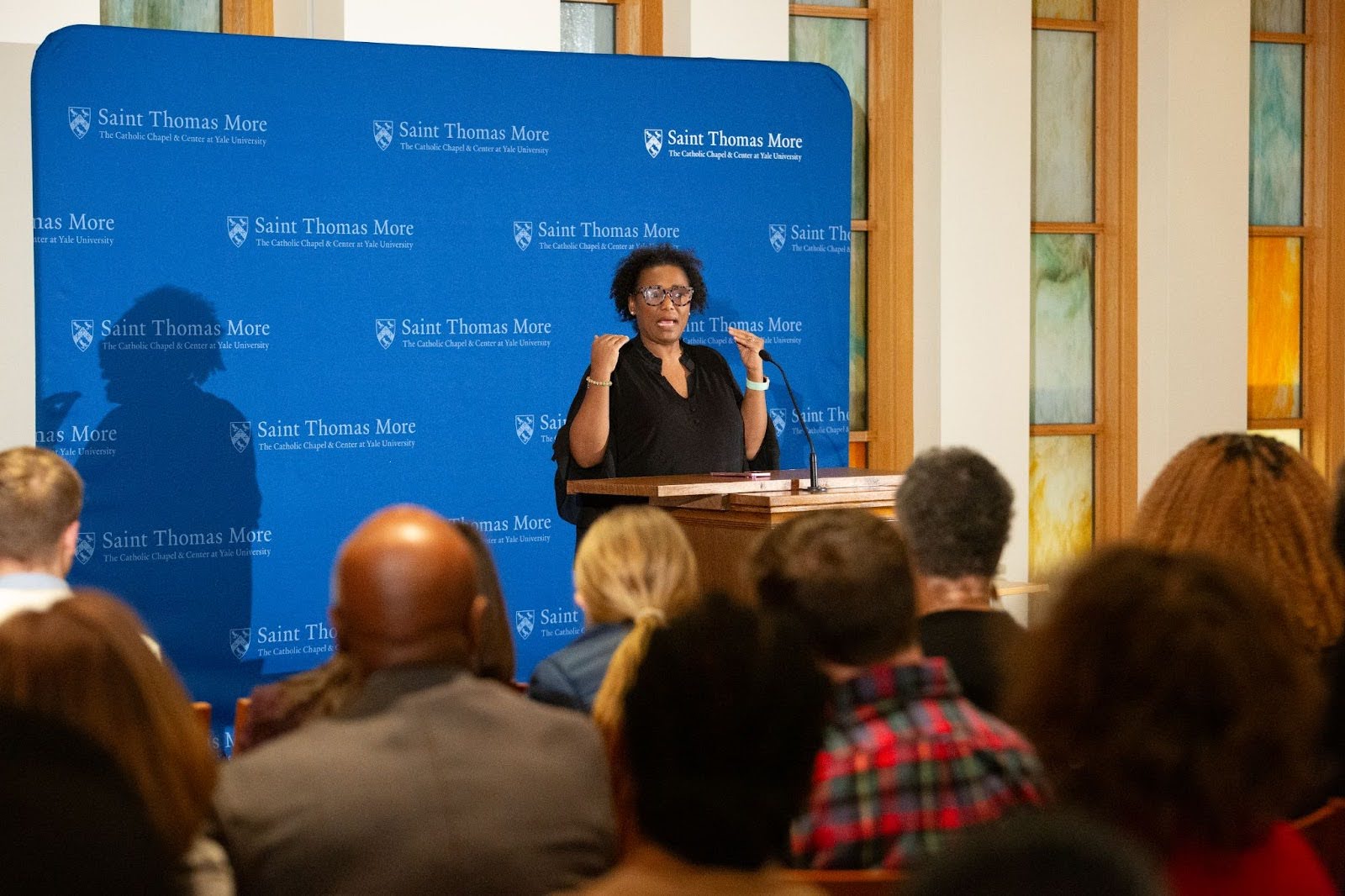
Gloria Purvis addresses the Saint Thomas More community on Sunday evening. (Credit: Nina Melendez at STM)
Jack Ehlert
Staff Writer, The Buckley Beacon
On February 15, Gloria Purvis, a Catholic speaker, scholar, and activist, gave a lecture entitled “Is Racial Justice Harmful?” at Saint Thomas More, Yale’s Catholic Chapel and Center.
Purvis was the inaugural Pastoral Fellow at Notre Dame’s Office of Life and Human Dignity and was recently appointed as an advisor in Providence College’s Office of Mission & Ministry. She has written for news outlets such as America: The Jesuit Review and National Catholic Reporter, contributed a course to the Word on Fire Institute, and is the host of The Gloria Purvis Podcast.
In her lecture, Purvis urged Catholics to speak up against the “long sin of racism” as it exists both in America’s past and present, advocating for greater Catholic engagement with this social justice issue.
Purvis began her talk with a story about the U.S. Air Force’s first “Top Gun” competition in 1949, noting that despite winning the competition, the all-Black team of Tuskegee Airmen went unrecognized for most of history. Purvis told the audience, “The Air Force said… their first Top Gun winner they had in the history books, they had ‘unknown.’”
Purvis cited this story as an example of how Black history has been suppressed in the United States, reinforcing the importance of recognizing February as Black History Month.
“This is why we need to know the stories of Black excellence,” Purvis told attendees, “Because if you had known those stories, you might not have fallen prey to the nonsense that if you see a Black pilot you should be worried.”
Purvis also discussed the Black heritage of newly-elected Pope Leo XIV, speculating “If somebody in his family didn’t pass for white, I don’t think he would’ve been pope. I don’t know if he would’ve been a priest in the United States.”
Throughout her lecture, Puvis emphasized that despite the fact that “people say slavery was such a long time ago,” stories from the time of slavery continue to be passed from generation to generation, allowing slavery to still exist “in the living memory of many people.”
Turning to the present day, Purvis lamented the Trump administration’s taking down of Black history educational materials from the Arlington National Cemetery website and its removal of information recognizing enslaved persons from an exhibit at the President’s House National Historical Site in Philadelphia.
Additionally, Purvis advocated for a broader meaning of the phrase “pro-life” in modern politics. Specifically, Purvis pointed to George Floyd’s death in 2020 as an example of a person being deprived of his “right to life” and “right to a natural death.”
“And those are things that in the pro-life movement they’re so animated about,” Purvis explained, “And yet, when it comes to this full-grown adult Black man, all the things that are said about the human person from the… dignity of the child from the womb to the tomb, somehow just evaporate.”
Although Purvis was critical of the Trump administration and other conservative figures such as Charlie Kirk and Jordan Peterson, she nevertheless encouraged Catholics to reject partisan politics, explaining, “I’m not a partisan… I’m on the side of Jesus Christ… It’s not gonna be whether it’s Republican or Democrat or independent. None of that stuff matters to me. It’s where is the truth? And where there isn’t truth, we need to say something about it.”
“If you say you love God, your life needs to show it,” Purvis told attendees, “Devotion, devoid of love of neighbor, is false. And racism definitely is not the love of neighbor.”
Purvis continued, “I remember so many Catholic apologists that I know saying things like systemic racism does not exist. And I was like, but the Catechism 1869 talks about personal sin, right? Personal sin, when all of us are committing personal sins, can build ‘structures of sin.’ And that’s exactly what Jim Crow was. That’s exactly what slavery was. That’s exactly what, frankly, mass incarceration is.”
During an interview with the Beacon, Purvis elaborated on the concept of “structures of sin,” describing how, even today, “the legacy of redlining is a problem.” In response to racism and other divisive social issues in American politics, Purvis advocated for the application of Catholic Social Teaching, urging Catholics to ask, “What kind of country do we want to have? What do we need to build the common good so that every individual and every human can flourish?”
Purvis was a keynote speaker at the 2024 National Eucharistic Conference.
Excellent reporting on an important topic.