Miguel Cardona justified the Department of Education’s existence by characterizing it as a civil rights agency.
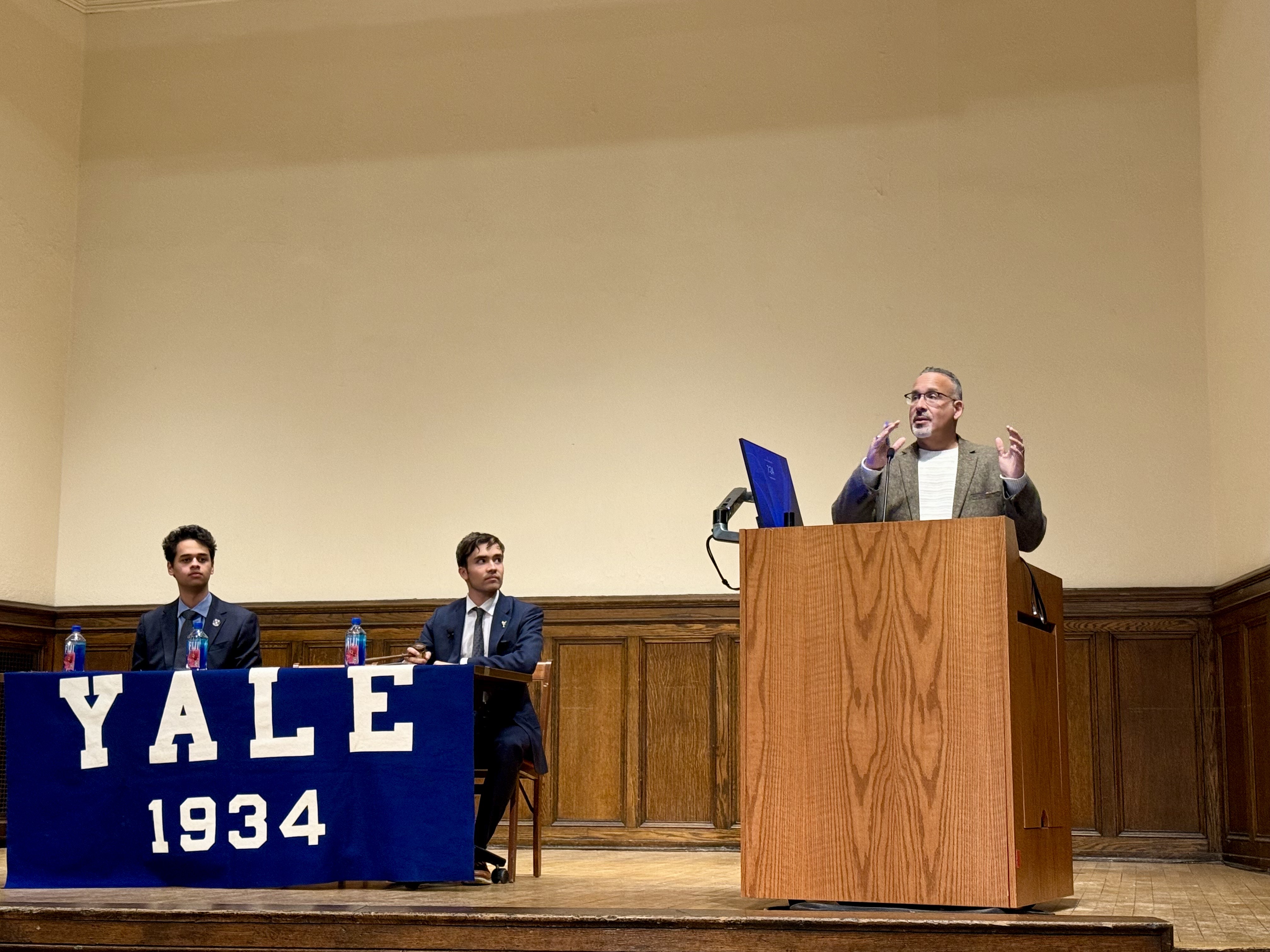
Miguel Cardona speaks at the YPU on Feb. 3. (Credit: Michelle Zheng)
Michelle Zheng
Managing Editor, The Buckley Beacon
On the evening of February 3, the Yale Political Union hosted the 12th Secretary of Education, Miguel Cardona. He argued in the affirmative for the proposition: Resolved: Save the Department of Education.
The Department of Education’s existence has been called into question under the Trump administration, with the president signing an executive order directing the current Education Secretary, Linda McMahon, to dismantle the department with the eventual goal of closing it. The administration has reportedly disrupted over $12 billion of funding to the department in 2025, mostly by cutting certain grants it administers.
Cardona, who served under President Joe Biden from 2021 to 2025, did not spend the evening insisting the department is efficient or beyond criticism. Instead, he framed the debate around which communities would be harmed first if the Department of Education is shuttered.
“Students with disabilities. English learners. Kids in rural communities. Poor communities. First-generation college students,” he said. “The students who rely on public education are the ones who lose first when federal oversight goes away.”
The discussion quickly moved away from bureaucratic structure and toward what Cardona repeatedly described as the department’s core function: a civil rights agency. He pointed to the role of the Office for Civil Rights, which enforces protections for students facing discrimination based on race, disability, language status, and gender. Federal enforcement ensures that a child from Kentucky is afforded the same legal protections as a child in California, despite local state politics.
The Department of Education is responsible for ensuring that free public education for students with disabilities is accessible and meets their needs by upholding federal laws such as the Individuals with Disabilities Education Act and Section 504 of the Rehabilitation Act. Through its Office of Special Education Programs, the department disburses funding to states, monitors compliance, and supports services for children from birth through age 21.
When audience members pressed him on why states could not follow those federal protocols independently, Cardona focused on accountability. “You said something important,” he told one student questioner. “Follow the same protocol. Who is making sure they actually do?” According to Cardona, protections become uneven and shaped by local politics without a federal body overseeing enforcement.
Cardona also referenced the department’s massive funding resources as justification for a federal education entity in lieu of 50 state entities. Money, he suggested, is where inconsistencies in civil rights become visible. Congress appropriates billions for education through programs like Title 1 for low-income schools, Title III for English learners, Pell Grants for college access, and special education funding. According to Cardona, the department’s responsibility is to ensure that money is used as Congress intended. Without that oversight, funds can be redirected toward political agendas or cosmetic projects. “You can have beautiful football fields in places where children can’t read,” he warned.
Cardona also tied the department’s role to oversight of higher education institutions, referencing federal action taken against for-profit colleges which “took advantage” of many low-income, first generation, and veteran students, who were left with debt and degrees of little value.
Several audience members opposed Cardona’s point, and instead held the belief that education decisions should be returned to the states. Cardona countered with personal experience. Having served as a teacher, a principal, Connecticut Commissioner of Education, and U.S Secretary of Education, he argued that curriculum has always been local. “As a fourth grade teacher, I had more control over what students learned than I did as Secretary,” he said. In his view, current federal overreach is not about imposing curriculum but about restricting what schools can address, pointing to cuts to diversity initiatives and pressure placed on universities from Washington.
Cardona backed up his support for federal oversight with personal experience. A Ohio school district superintendent that Cardona visited was required to divert $12 million from public schools to fund a school choice voucher program. After the official student count day which allocates funding to schools based on the number of students, special needs students who took the vouchers to go to private institutions were recommended to return to public schools, where there were more resources. The funding did not return with them. “The public schools ended up educating the most expensive-to-teach students with less funding,” Cardona said. “That is how you dismantle public education without saying you are dismantling public education.”
Near the end of Cardona’s speech, a student challenged Cardona’s assertion that without the Education Department, public education erodes, and without public education, democracy erodes. The claim sounded rhetorically powerful, the student criticized, but it lacked a clear connection between the department and the erosion of democracy. Cardona responded with a story from a conversation with a young man from Afghanistan, who described how restricting education weakened democratic participation. Public education, Cardona argued, is where civic norms and democratic principles are learned. “Public education protects democracy,” he said. “That’s where you learn how it works.”
Throughout the evening, Cardona returned to his own story. As a child, he entered kindergarten as an English learner from an economically disadvantaged community in Meriden, Connecticut. He credited public education and after-school programs for providing opportunities his family could not afford. “If you were a betting person, you wouldn’t bet on my odds,” he said. “But public education made it possible for that young boy to one day advise the President of the United States.”
When asked what needs to be fixed in the Education Department, he cited slow adaptation to student needs, rising partisanship in Washington, and the need to better address mental health and college readiness. “We’re not here to talk about making it better,” he reminded the audience. “We’re here to decide if we should have an agency that protects the civil rights of students.”
His closing line drew the loudest response of the night. “From the barrio to the West Wing…” he said, “that’s only possible because of public education.”
The Yale Political Union’s resolution passed 59-11-2.